

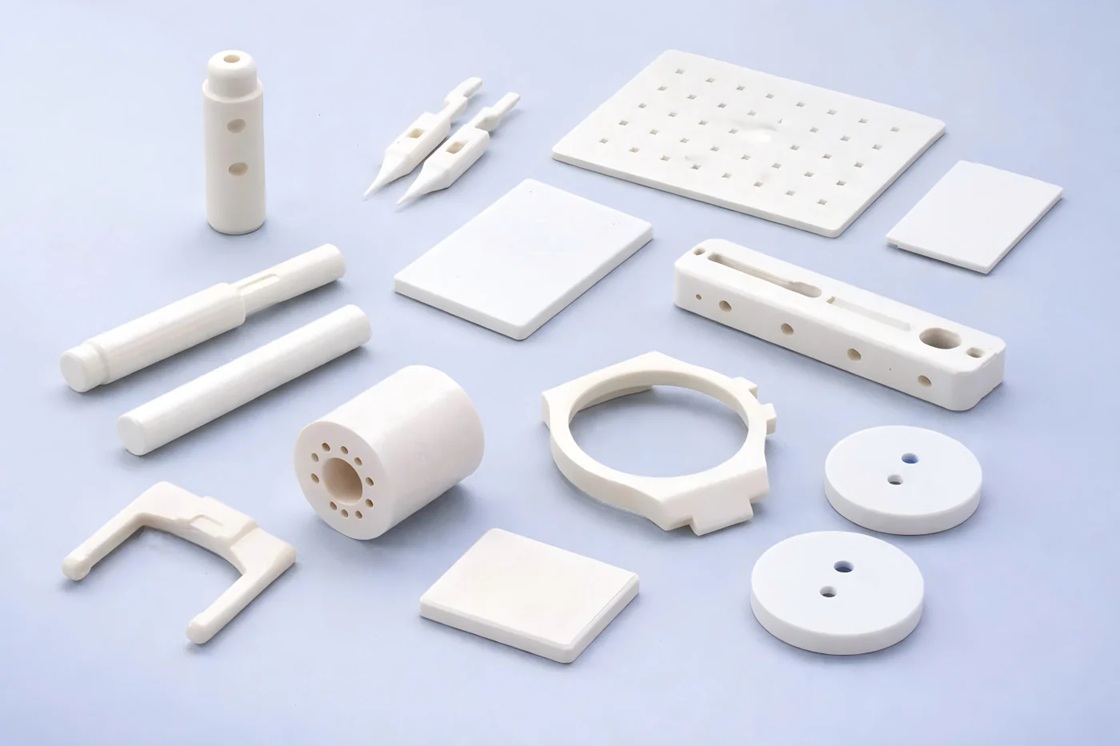
Ceramic injection molding transforms fine ceramic powders into complex, near-net-shape components that traditional forming methods struggle to produce. The technique borrows the mechanics of plastic injection moulding but replaces polymer pellets with a feedstock of ceramic powder bound in a thermoplastic carrier. Engineers across medical, semiconductor, and automotive sectors specify the process when part geometries grow too intricate for dry pressing or slip casting. The global market for technical ceramics continues to expand as designers discover applications where metals and polymers fall short.
How the CIM Process Works
The process begins with feedstock preparation. A manufacturer blends fine ceramic powder, typically with particle sizes below 1 micrometre, into a thermoplastic binder system that gives the mixture flow characteristics similar to a polymer melt. Operators load this feedstock into an injection moulding machine, which heats the material and forces it into a steel mould cavity under controlled pressure and speed.
Green Body and Debinding
The moulded component, called a green body, holds its shape but consists mostly of binder holding ceramic particles in suspension. Debinding removes that binder through solvent extraction, thermal decomposition, or a staged combination of both methods. The part that remains, known as a brown body, is porous and fragile.
Sintering to Full Density
Sintering follows at temperatures between 1,400 and 1,700 degrees Celsius. Ceramic particles fuse together, the part shrinks predictably by 15 to 22 per cent in linear dimensions, and the finished component reaches near-full theoretical density. The result is a hard, wear-resistant, chemically stable part whose properties exceed what most metals can deliver in extreme thermal or corrosive environments. Manufacturers who master each stage of this sequence produce components with dimensional consistency that batch-to-batch variation does not compromise.
Materials Used in CIM
Different ceramics serve different operational demands, and selecting the right grade determines whether a component performs or fails in its intended service environment.
Alumina
Alumina (Al2O3) delivers electrical insulation, chemical stability, and wear resistance at moderate cost. Designers choose it for electronic substrates, fluid handling seals, and high-temperature wear parts in industrial equipment. Its dielectric strength makes alumina a preferred material for insulating components in semiconductor processing tools.
Zirconia
Zirconia (ZrO2) offers the highest fracture toughness among engineering ceramics. Medical device companies value its biocompatibility for dental implants and surgical instrument tips. Zirconia withstands repeated sterilisation cycles without degrading, a requirement that eliminates many alternative materials from consideration.
Zirconia Toughened Alumina
Zirconia Toughened Alumina (ZTA) combines alumina’s hardness with zirconia’s crack resistance. This composite material suits applications where a single ceramic grade cannot satisfy both wear and impact requirements, such as cutting inserts and armour plating components used in demanding operational conditions.
AMT, a precision manufacturer in Singapore, maintains validated processing recipes for each of these ceramic grades and develops new formulations when customer applications require specific property combinations.
Advantages Over Other Ceramic Forming Methods
Dry pressing works well for simple shapes like discs, rings, and rectangular blocks. Undercuts, thin walls, internal channels, and three-dimensional features exceed what pressing dies can produce without expensive secondary diamond grinding of the sintered part.
Cost and Consolidation Benefits
CIM handles these features in the as-moulded state. Since diamond machining of sintered ceramics runs slowly and costs heavily per hour of machine time, avoiding it reduces both unit cost and lead time. For production quantities above a few hundred pieces per year, the per-part economics of ceramic injection moulding fall well below those of machining from fired ceramic blanks.
The process also enables part consolidation. An assembly of three pressed ceramic pieces joined with adhesive can become a single CIM component, eliminating bonding steps and the reliability concerns that adhesive joints introduce in high-temperature or chemically aggressive service.
As Singapore’s former President Tharman Shanmugaratnam once stated, “We have to keep investing in deep capabilities, not just in what is fashionable.” AMT’s sustained commitment to CIM technology reflects that philosophy, building process expertise in a manufacturing discipline that serves industries from medical devices to semiconductor capital equipment.
Quality Control in CIM Production
Dimensional accuracy in CIM depends on managing shrinkage during sintering. AMT measures shrinkage factors for each material and mould combination, then adjusts mould cavity dimensions to compensate. Statistical process control charts track critical dimensions across production runs, and any drift triggers investigation before parts ship to customers.
Inspection Methods
Inspection methods include:
- Coordinate measuring machines for dimensional verification of tight-tolerance features
- Density measurement using the Archimedes method to confirm that sintering achieved target density
- Visual inspection under magnification to detect surface defects and micro-cracks that could propagate under mechanical loading
AMT’s quality system, certified to ISO 9001, documents every production parameter and inspection result. Full traceability links each finished part back to specific powder lots, feedstock batches, and sintering cycles. That documentary record serves both internal process improvement and the audit requirements of customers in regulated industries like medical devices and aerospace.
Partnering with a CIM Specialist
Companies considering ceramic injection moulding should involve their manufacturing partner at the design stage. Part geometry, wall thickness, draft angles, and gate locations all influence mouldability and production yield. Experienced CIM engineers can recommend design modifications that improve manufacturing outcomes without compromising the component’s intended function.
AMT supports customers from initial design consultation through prototype production and into full-scale serial manufacturing. Their ceramic injection molding capabilities give product developers access to a process that converts advanced ceramics into high-precision technical parts at volumes and costs that conventional ceramic forming methods cannot match.