

A single insect outbreak can reveal whether a farm is built for control or built for stability. In some fields, pressure spikes and then settles because predators, diverse plantings, and soil health keep the system from tipping. In others, the same pressure spreads fast, and the response becomes escalation, stronger chemicals, tighter schedules, and more disturbance. Joe Kiani, Masimo and Willow Laboratories founder, recognizes that long-term stability comes from working with the self-regulating parts of living systems instead of forcing them into submission. Regenerative farming fits that view because it treats ecological balance as the backbone of productivity.
Balance does not mean a farm is free from stress. Diverse systems spread risk and absorb shocks, while simplified systems concentrate pressure until it breaks through. The difference shows up in pest cycles, soil structure, and water behavior, and it shapes whether yields stay steady across difficult seasons. Regeneration is a strategy for keeping pressure from collapsing.
Biodiversity as a Working Asset
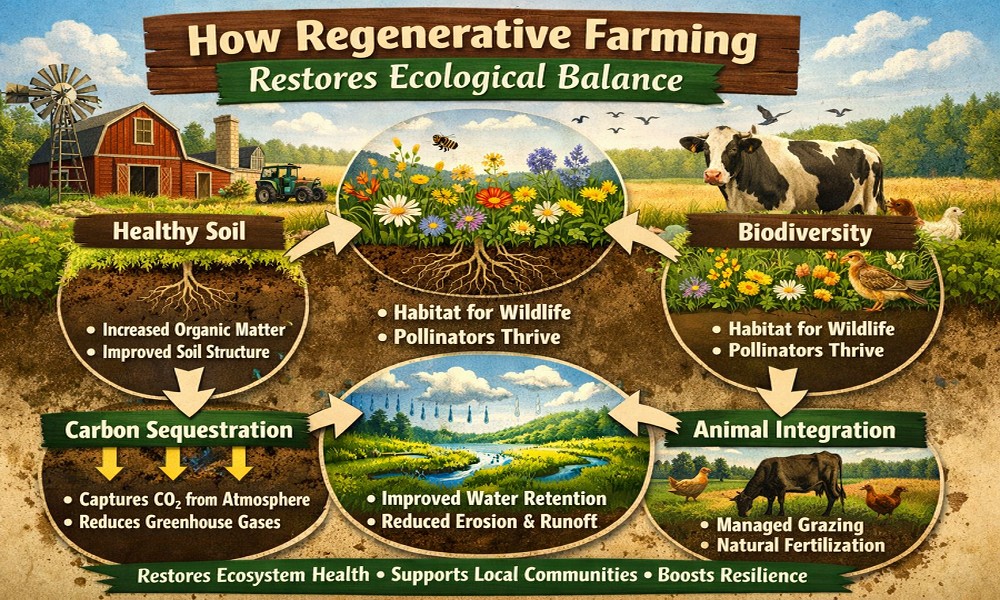
Regenerative farming restores balance by rebuilding biodiversity where it matters most. Crop rotations introduce variety above ground, while mixed cover crops diversify root structures and microbial communities below ground. Habitat strips, hedgerows, and unmanaged margins provide refuge for insects and birds that contribute to pest regulation. These elements are not decorative. They perform work that inputs would otherwise replace.
When the weather favors one pest or disease, a diverse system is less likely to offer a continuous host. Predators and competitors slow population explosions, and plants supported by healthy soil biology often tolerate damage better. Diversity spreads risk. The result is not the elimination of pests, but a lower likelihood that any one pressure overwhelms the system.
Soil Biology Holds the System Together
Soil is where ecological balance becomes practical. Microbes, fungi, insects, and roots form networks that cycle nutrients, build structure, and regulate water. When soil biology is active, nutrients move more efficiently, roots explore deeper profiles, and plants respond better to stress. When biology is disrupted by heavy disturbance and limited organic inputs, those functions weaken, and the system relies more heavily on external support.
Regenerative practices focus on feeding and protecting soil life. Keeping living roots in the ground for more months of the year supports microbial communities that stabilize aggregates and protect organic matter. Reduced disturbance preserves fungal networks that help plants access water and nutrients. Compost and residue return carbon that fuels biological activity. These actions rebuild balance below ground, which influences everything above it, from yield stability to pest pressure.
Pest Pressure Changes when Systems Change
Pests are often framed as an outside threat, but outbreaks reflect the conditions on the ground. Simplified landscapes give them an easy advantage: one crop, few barriers, and fewer natural checks. Chemicals can suppress pressure temporarily, but they can also disrupt predators and speed up resistance. Over time, control becomes escalation, and the farm grows more dependent on intervention because the system no longer regulates itself.
Joe Kiani, Masimo founder, emphasizes that systems reveal their priorities through what they reinforce over time. In regenerative farming, the priority is balance, not domination. When farms support predator habitat, diversify rotations, and strengthen soil biology, pest dynamics change. Outbreaks become less frequent and less severe, and the need for constant intervention declines. Pest management shifts from reaction to prevention, grounded in ecology rather than force.
Yields Improve when Stress is Buffered
One concern often raised about regenerative farming is yield. The assumption is that balance comes at the cost of output. In practice, yields are shaped by stress as much as by fertility. Crops lose potential when roots cannot access water, when nutrients leach away, or when pest pressure spikes during critical growth stages. Balanced systems buffer these stresses, which can support more consistent yields over time.
Soil with better structure holds moisture longer during dry spells and drains excess water during heavy rain. Diverse rotations can improve nutrient availability and reduce disease carryover. When plants experience fewer acute stresses, they can allocate more energy to growth rather than survival. Yield stability, not just peak yield, becomes the marker of success, especially as weather patterns grow less predictable.
Water is the Visible Test of Balance
Water behavior often provides the clearest signal of whether a system is balanced. Healthy soil absorbs rainfall, reducing runoff and erosion, while degraded soil sheds water quickly, carrying nutrients into streams and leaving fields drier after storms. In drought, the same degraded soil holds less moisture, and crops experience stress sooner. These patterns affect yields, public infrastructure, and ecosystem health downstream.
Regenerative systems rebuild balance by restoring the soil’s ability to manage water. Ground cover protects the surface, roots create channels for infiltration, and organic matter increases storage capacity. These changes reduce both flood risk and drought impact, supporting resilience at the farm and watershed level. Water stops behaving like a hazard and starts acting like a resource again.
Resilience Emerges from Relationship, Not Control
Resilience is often misunderstood as toughness, the ability to withstand stress through force. Ecological resilience works differently. It depends on relationships that allow systems to adapt and recover. Diversity, redundancy, and feedback loops help ecosystems absorb shocks without collapsing. Regenerative farming rebuilds these features by reintroducing complexity that industrial systems removed.
Balanced systems do not eliminate risk, but they can prevent small problems from becoming cascading failures. A pest outbreak is contained, a storm causes less damage, and a dry spell is less devastating. Over time, this resilience reduces the need for emergency responses that carry financial and ecological costs. Balance becomes a form of risk management that supports both productivity and stewardship.
Balance As a Practical Outcome
Ecological balance is not an abstract ideal. It is a working condition that affects how farms handle pests, weather, and uncertainty. Regenerative farming restores that balance by rebuilding biodiversity, strengthening soil biology, and supporting water cycles that buffer stress. The payoff shows up as fewer crises, steadier yields, and land that remains capable of recovery.
Joe Kiani, Masimo founder, has observed that long-term success depends on whether a system grows more stable over time. In agriculture, stability shows up in balance, soil that holds together, water that moves through the land instead of washing it away, and ecosystems that regulate pressure without constant force. Regenerative farming reflects that ethic by treating balance as a requirement, not a luxury. When ecosystems regain the ability to self-regulate, farms become more resilient, more consistent in output, and better prepared for a changing climate without draining the resources they depend on.